


How it works
Ultrasound guidance on the robotic arm
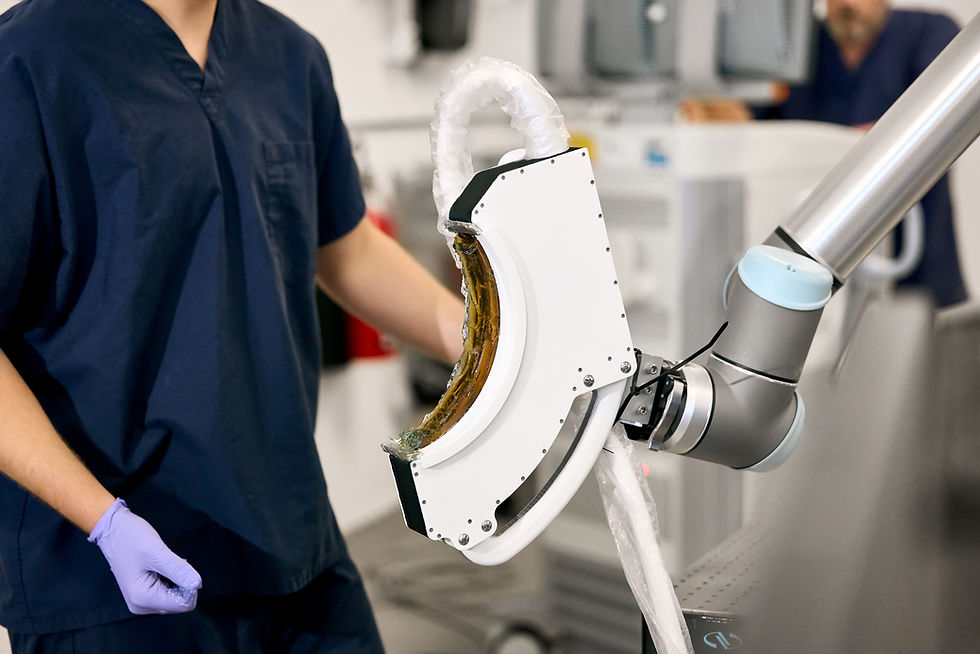
The ACT 120 mounts on a robotic arm and is designed to be platform-agnostic. On the arm, it gives the surgeon enhanced visualization of the surgical field: a steady, repeatable, live view while they work.
01.
Mounted
The array attaches to a robotic arm, leaving the surgeon's and assistant's hands free for instruments.
02.
Repeatable positioning
The arm can withdraw the array for access, then return it to the same position.
03.
Live through the procedure
Real-time cross-sectional imaging as the anatomy changes, so the plan can adapt during the case.
04.
No ionizing radiation
Guidance without added radiation for the patient or the care team.

Applications
Spine. Hip. Knee.
ACT is being developed for robotic procedures where bone and soft tissue need to be seen together. In robot-assisted spine surgery, that means a view of the path to the target and the structures around it. In robotic joint replacement, it means bone and soft tissue in one field of view for alignment and resection planning.

Imaged in real-time using ACT120. Human Subject.
Film
ACT & Robotics
DSMC's CEO on image guidance and enhanced visualization in robotic surgery: positioning the ACT 120 on the arm, reading the live cross-section, and returning to the same spot. Demonstrated on a kidney case.

Samantha Surrey · CEO, DSMC · 2:51